How to Optimize for AI Search
Practical, hands-on strategies to get your brand mentioned and recommended by AI engines.
7 min read
The Core Architecture: Understanding the AI Retrieval Loop
To expand on the framework of optimizing for AI search (often referred to as Generative Engine Optimization or GEO), we need to look at how to shift a website's architecture from appealing to standard keyword crawlers to appealing to Retrieval-Augmented Generation (RAG) systems.
When platforms like ChatGPT Search, Perplexity, Google AI Overviews, and Microsoft Copilot crawl the web to answer a user's prompt, they aren't looking for keyword density—they are looking for fact density, structural predictability, and information gain.
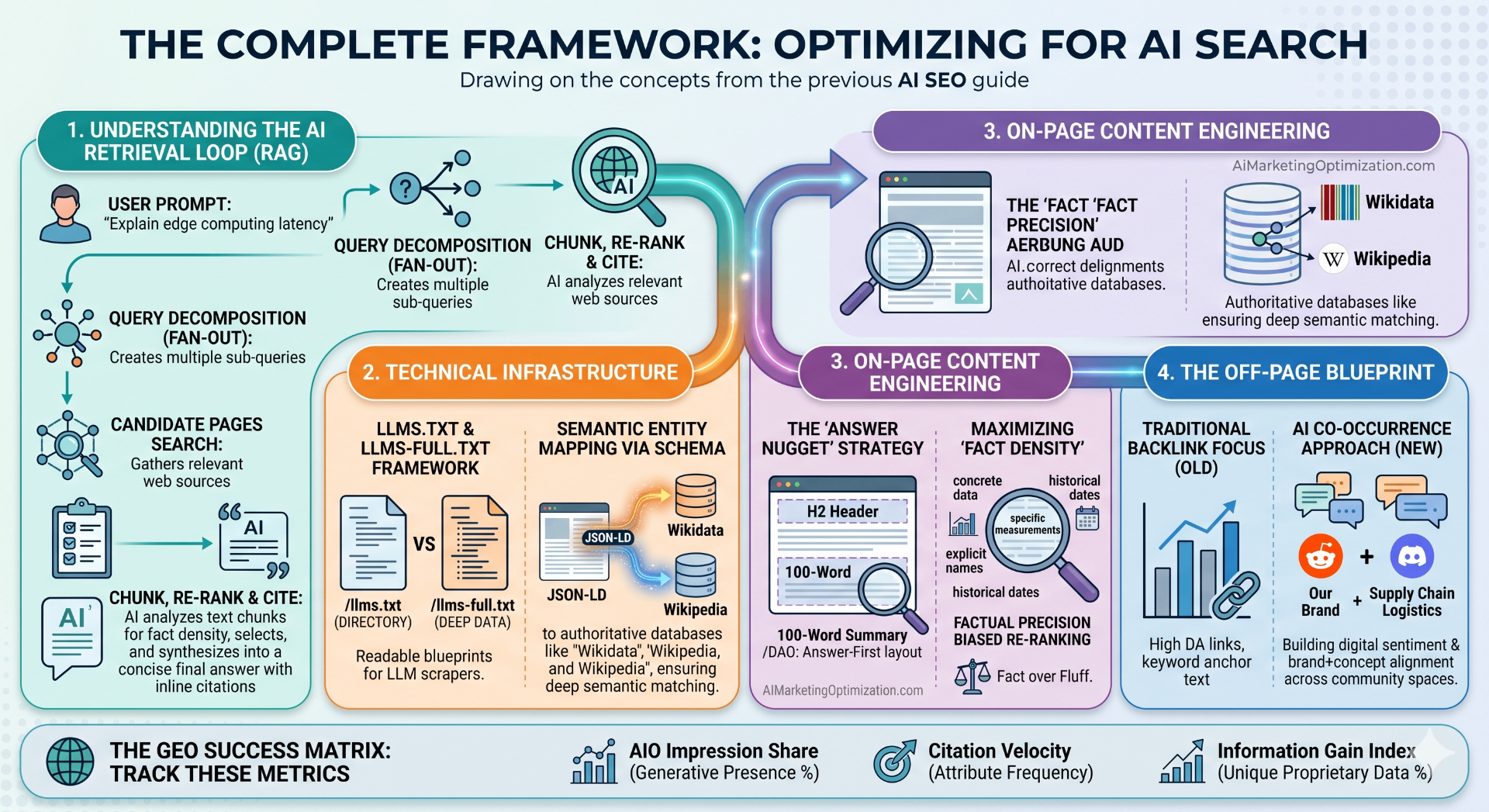
Before implementing changes, a creator must understand exactly how an AI search engine treats a webpage. The journey from a user's prompt to an AI citation happens in four rapid phases:
[User Prompt] ──► [Query Decomposition] ──► [Vector / Vector-Hybrid Search] ──► [RAG Re-Ranking & Citation]- Query Decomposition (Fan-Out): The AI engine takes a natural, conversational prompt and breaks it into 3–5 hidden sub-queries to capture the user's implicit needs.
- Vector/Hybrid Search: The engine searches the live web for pages that match the semantic meaning of those sub-queries, pulling a pool of 10 to 30 'candidate pages.'
- Chunking & Parsing: The AI crawler strips the HTML from those candidate pages, breaks the text into small 'chunks' (usually 100–300 words), and reads them.
- Re-Ranking & Synthesis: The engine scores each chunk based on Fact Density and Source Authority. The highest-scoring chunks are synthesized into the final conversational answer, and their URLs are attached as inline citations.
Technical Infrastructure for AI Optimization
Traditional technical SEO optimizes for Googlebot. AI Search Optimization requires optimizing for LLM scraper bots (like GPTBot, PerplexityBot, or OAI-SearchBot).
The Dual llms.txt and llms-full.txt Framework
Just as robots.txt guides traditional crawlers, the newly established llms.txt standard provides a clean, markdown-formatted roadmap specifically for AI models. It sits in your website's root directory (yourwebsite.com/llms.txt) and serves as a lightweight, text-only directory that prevents the AI from burning its context window on messy HTML or navigation menus.
- llms.txt (The Summary File): A concise markdown file detailing what your site is about, the core entities you cover, and a curated list of your most authoritative, data-rich URLs.
- llms-full.txt (The Comprehensive File): A deeper file containing full text expansions of your core research, data tables, and whitepapers so an AI can ingest your proprietary insights entirely in plain text without needing to parse complex page layouts.
Semantic Entity Mapping via Schema
AI models understand the world through a Knowledge Graph—a web of connected 'Entities' (concepts, people, brands, places). To optimize for AI search, you must explicitly declare your entities using deeply nested JSON-LD Schema Markup.
Instead of just using basic article schema, use about and mentions arrays to connect your content directly to verified entries in authoritative databases like Wikidata or Wikipedia.
Example: If writing about supply chain logistics, your code should explicitly map your text to the precise Wikidata ID for 'Supply Chain Management,' signaling an undeniable semantic match to the AI.
On-Page Content Engineering: The 'Answer Nugget' Strategy
AI search engines favor extreme clarity. If your content forces a machine to read through a long, narrative story before getting to the point, your page will be dropped during the re-ranking phase.
The 100-Word Summary Framework
To win the featured summary citation in an AI Overview, adopt an 'Answer-First' layout. Directly beneath your primary header (H2), place a highly dense, 2-to-3 sentence declarative statement that answers the core question explicitly.
Bad (Traditional 'Clickbait' SEO): 'To understand how edge computing impacts latency, we first have to look back at the history of cloud infrastructure and how servers evolved...'
Good (AI Search Optimized): 'Edge computing reduces application latency to under 12 milliseconds by processing data locally on decentralized gateway chipsets. This architecture eliminates backhaul round-trips to centralized cloud servers, resulting in an 84% reduction in data transmission lag.'
Maximizing 'Fact Density'
AI re-ranking algorithms are mathematically biased toward text strings that contain concrete data points, specific measurements, explicit names, and historical dates.
Replace vague phrases like 'Our software makes your team significantly faster' with 'Our platform automates data indexing, reducing manual sorting times from 4.2 hours to 18 minutes per sprint.'
The higher the concentration of verifiable facts per paragraph, the more reliable the chunk appears to a RAG re-ranking algorithm.
The Off-Page Blueprint: Building Digital Sentiment and Co-Occurrence
Traditional off-page optimization relies heavily on hyperlinks and Domain Authority. AI engines, however, evaluate brand trust by scraping the web broadly for unlinked brand mentions and sentiment patterns across community spaces.
| Strategy Vector | Traditional Backlink Approach | AI Co-Occurrence Approach |
|---|---|---|
| Authority Focus | High DA (Domain Authority) websites linking to your target page. | Clean, non-spammy entity alignment across industry discussions, community forums, and digital PR. |
| Anchor Text | Keyword-rich anchor text strings (e.g., 'click here for best project management software'). | Brand + Concept Co-occurrence: Ensuring your brand name appears frequently in the same paragraph as your target industry terms. |
| Discovery Source | Search engine index graphs. | Specialized training datasets, public forums, and academic or trade publications. |
The Co-Occurrence Strategy
If an LLM crawls thousands of user discussions on platforms like Reddit, Discord, and niche industry forums, it tracks which brands are mentioned alongside specific problems. If your brand name regularly appears in close proximity to phrases like 'enterprise cybersecurity for remote teams,' the model's vector embedding weights will naturally cluster your brand node with that solution.
When a user asks an AI search engine for a recommendation, the model draws on these learned associations to name your brand—even if you don't have a traditional backlink from a major media site.
Transitioning to AI Search Metrics
As AI search adoption increases, classic organic click-through rates (CTR) and keyword rankings become volatile, disrupted by 'zero-click' AI answers. To accurately measure success, websites must track new metrics:
- AIO Impression Share (AI Overview Presence): The percentage of your core target search queries where your brand is cited inside the generative answer layout.
- Citation Velocity: The frequency with which conversational search engines pull and attribute data fragments from your domain over a rolling 30-day period.
- Information Gain Index: An internal editorial audit ensuring every new article contains at least 30% entirely unique data points, proprietary imagery, or case study metrics not currently found in the top 5 organic search results.
Keep reading
AI SEO has two sides: using AI to boost your internal workflow, and optimizing your content so AI search engines actually cite you.
How to optimize for AI search and generative answers across ChatGPT, Gemini, Claude, and Perplexity.