
AIO: Artificial Intelligence Optimization Explained
AI SEO has two sides: using AI to boost your internal workflow, and optimizing your content so AI search engines actually cite you.
8 min read
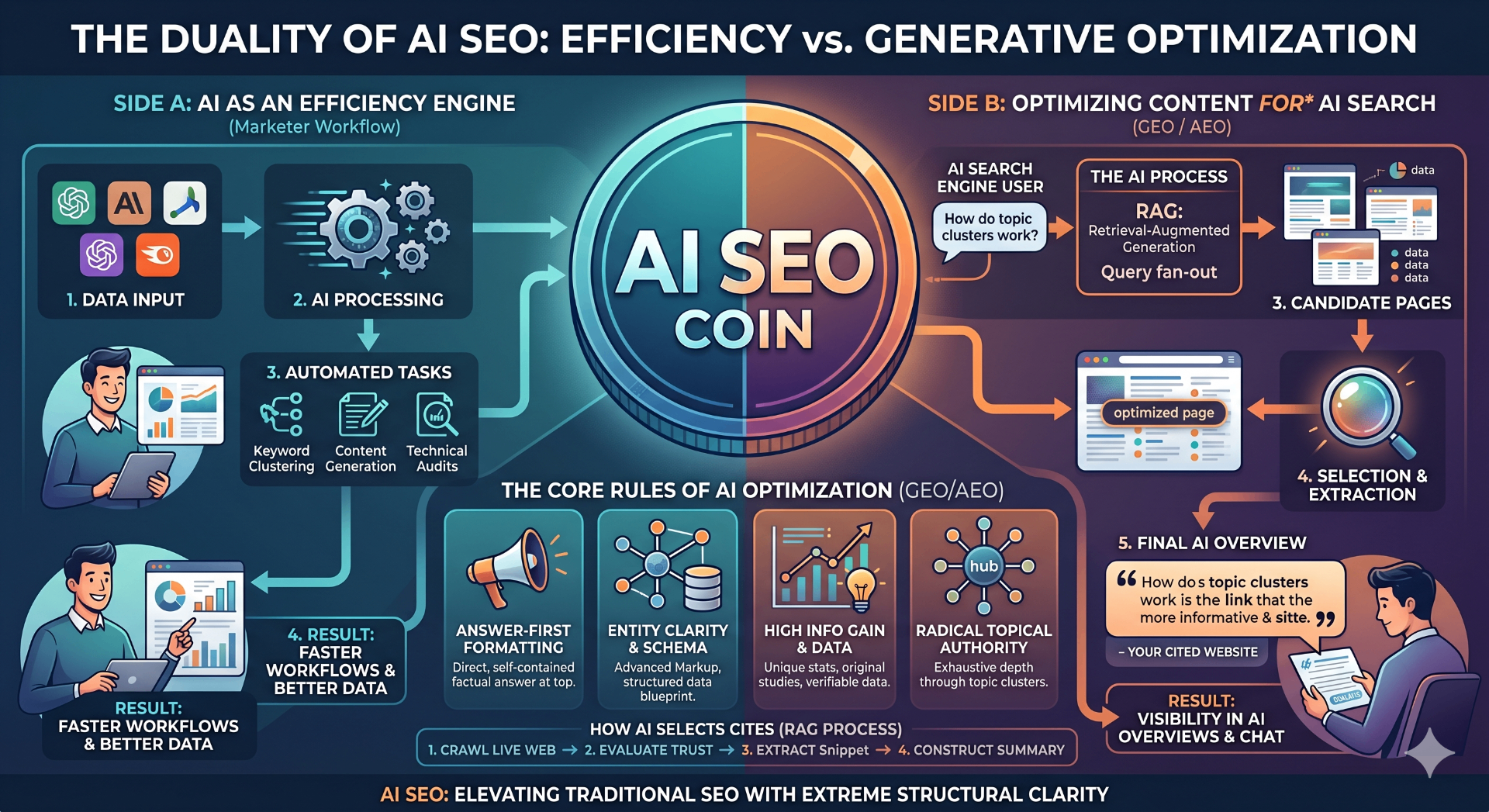
The Two Sides of AI SEO
AI SEO is a term that gets thrown around a lot, but it actually has two distinct sides. Think of it as a coin: one side is using AI tools to do traditional SEO work faster, and the other side is optimizing your website so that AI search engines actually recommend and cite you.
To really get it, we have to split the definition into how marketers use it versus how search engines process it.
Side A: Using AI as an Efficiency Engine
This is the internal workflow. Instead of spending days doing manual research, digital marketers use artificial intelligence (tools like ChatGPT, Claude, Midjourney, or specialized SEO software like SurferSEO and Nightwatch) to automate heavy data lifting.
Keyword Clustering: Grouping thousands of keywords by semantic intent in seconds.
Content Generation & Optimization: Writing first drafts, analyzing content gaps against competitors, and injecting missing semantic terms.
Technical Audits: Instantly scanning large websites to spot broken links, code errors, or schema issues.
Side B: Optimizing Content for AI Search (GEO / AEO)
This is where the industry has drastically shifted. People aren't just clicking the classic '10 blue links' on Google anymore; they are asking questions directly to Google AI Overviews (AI Mode), ChatGPT Search, Perplexity, and Copilot.
Optimizing for these platforms is often called Generative Engine Optimization (GEO) or Answer Engine Optimization (AEO). The goal here isn't just to rank #1—it is to get the AI to extract your text and cite your website as its trusted source.
How AI Search Engines Choose Who to Cite
When you ask an AI engine a question, it doesn't just guess the answer from its static training data. It uses a process called RAG (Retrieval-Augmented Generation).
Behind the scenes, the AI breaks your question into multiple sub-queries (a process Google calls query fan-out), crawls the live web to find relevant pages, ranks those pages for trustworthiness, extracts the best snippets, and pieces them together into a single cohesive summary.
To be the website the AI pulls from, your content has to meet very specific technical and structural criteria.
The Core Rules of AI Optimization
If you want an AI engine to read, trust, and quote your website, your content strategy needs to adapt to how machines process data.
Rule 1: The 'Answer-First' Formatting
Traditional SEO content often rambles or builds up to a conclusion to keep users scrolling. AI hates this. If your main point is buried in paragraph four, the AI will skip you.
The Fix: Lead with a direct, self-contained, factual answer right at the top of the page or section. Treat your headers like questions and the immediate sentence below it as the definitive answer. Studies show AI pulls from the opening paragraph for more than 44% of its citations.
Rule 2: Entity Clarity & Schema Markup
AI engines don't just look for isolated keywords anymore; they look for entities (specific people, places, organizations, and concepts) and how they connect.
The Fix: Use advanced Schema Markup (FAQ schema, Product schema, Author schema). This provides a clean, machine-readable code blueprint that tells the AI exactly what your data means without making it guess.
Rule 3: High Information Gain & Hard Data
AI models are heavily trained to avoid fluff. If your article says the exact same thing as twenty other blogs on the web, an AI search engine has no reason to prioritize you.
The Fix: Focus on information gain—unique statistics, original case studies, and proprietary data. Back up your claims by linking to credible sources. AI evaluation models strongly favor content with verifiable data points.
Rule 4: Radical Topical Authority
AI prefers deep, tightly-scoped topic experts over generalist sites.
The Fix: Build 'topic clusters.' Instead of writing one massive, encyclopedic guide that covers everything shallowly, build a hub page and link it to dozens of highly specific, short, dedicated sub-pages that exhaustively cover individual sub-topics.
The Takeaway
AI SEO hasn't replaced traditional SEO—it has elevated it. The structural cleanliness, site speed, and mobile responsiveness required by classic Google algorithms are still the foundation. AI SEO simply adds a layer of extreme structural clarity and factual precision on top, ensuring both humans and algorithms can instantly extract value from your site.