The Guide to Generative Engine Optimization
How to optimize for AI search and generative answers across ChatGPT, Gemini, Claude, and Perplexity.
10 min read
Core Mechanics: The RAG & Query 'Fan-Out' Bottleneck
The fundamental shift from traditional Search Engine Optimization (SEO) to Generative Engine Optimization (GEO) requires moving from keyword indexability to semantic information extraction. When engines like Google AI Overviews, ChatGPT Search, Perplexity, or Copilot respond to a prompt, they execute a retrieval bottleneck.
AI search engines rarely rely purely on their static pre-trained weights to answer commercial or transactional queries. Instead, they operate via RAG (Retrieval-Augmented Generation):
[User Natural Prompt]
       │
       ▼
[Query Fan-Out System] ──► Breaks down prompt into 3-5 structural sub-queries
       │
       ▼
[Live Vector Search] ──► Crawls web to pull top 10–20 'candidate pages'
       │
       ▼
[Synthesis & Re-ranking] ──► LLM reads candidate fragments for 'Fact Density'
       │
       ▼
[Generative Response] ──► Assembles response and applies inline citations
To survive the Synthesis and Re-ranking stage, content cannot be fluffy or narrative-driven. It must be dense, easily tokenized, and configured to answer secondary 'fan-out' queries.
- Query Fan-Out Strategy: If a user searches 'What is the best enterprise CRM for remote teams?', the AI engine internally generates sub-queries like 'enterprise CRM remote team features,' 'CRM pricing comparison 2026,' and 'remote sales software reviews.' Your article must explicitly structure its headers (H2s and H3s) to mirror these sub-queries, creating an exact textual match for the AI's internal retrieval loops.
Technical Implementation: From Markup to Machine Interfaces
Traditional technical SEO focuses on title tags, meta descriptions, and XML sitemaps. GEO redefines technical performance, treating your webpage like a clean API interface designed for an LLM parser.
A. Implementing llms.txt and llms-full.txt
In addition to a standard robots.txt file, websites must now host an llms.txt file in their root directory (/llms.txt). This is a markdown file that provides a clean, context-dense summary of your website configuration specifically for AI crawlers, bypassing messy HTML code.
# Title: Enterprise Security Solutions

## Core Entities
- Primary Product: CyberShield Core (Enterprise EDR Software)
- Parent Organization: SecureCorp Systems, Inc.

## High-Value Resource Summaries
- [/products/edr-core]: Technical documentation, pricing tiers, and direct API integration specifications for CyberShield Core.
- [/research/2026-threat-report]: Proprietary malware data, zero-day mitigation statistics, and vector analysis.
B. Deep Entity Mapping via Advanced JSON-LD
Standard Schema markup is no longer enough to establish a footprint. To ensure the AI's underlying knowledge graph connects your brand node with specific industry keywords, you must declare Primary and Connected Entities within a nested TechArticle or Product schema using sameAs attributes linking to authoritative databases like Wikidata.
{
  "@context": "https://schema.org",
  "@type": "TechArticle",
  "headline": "Advanced Generative Engine Optimization Architectures",
  "author": {
    "@type": "Person",
    "name": "Alex Mercer",
    "jobTitle": "Principal AI Architect",
    "sameAs": "https://www.wikidata.org/wiki/Q114838456"
  },
  "about": [
    {
      "@type": "Thing",
      "name": "Retrieval-Augmented Generation",
      "sameAs": "https://en.wikipedia.org/wiki/Retrieval-augmented_generation"
    }
  ],
  "mainEntity": {
    "@type": "DataFeed",
    "name": "2026 Enterprise Search Metrics"
  }
}
C. Token Optimization and Page Cleanliness
AI crawlers do not read pages the way web browsers render them. They strip the HTML down to text and split it into tokens. If your site is bloated with massive JavaScript tracking scripts, layout shifts, or redundant CSS, the crawler's context window may cut off before it reaches your high-value insights. Keep your DOM tree shallow and pre-render content server-side so it is instantly parsable.
On-Page Structure: The 'Answer Nugget' Framework
LLMs prioritize content efficiency. If you force an AI to parse 500 words of introductory storytelling before answering a core question, your site will be filtered out.
| Optimization Vector | Traditional SEO Approach | GEO / AI Search Approach |
|---|---|---|
| Introductory Text | Contextual build-up, definitions, history. | Direct Answer Optimization (DAO): The 100-word summary framework at the very top. |
| Structural Layout | Keyword-optimized paragraphs. | Clear H2/H3 question hierarchies, tables, and bullet processes. |
| Content Density | High word count focused on semantic keyword synonyms. | Fact Density: Heavy integration of proprietary data, dates, and explicit source metrics. |
| Expertise Signal | Author name on page. | Nested Author Profiles linked to verified professional repositories. |
Designing the 'Answer Nugget'
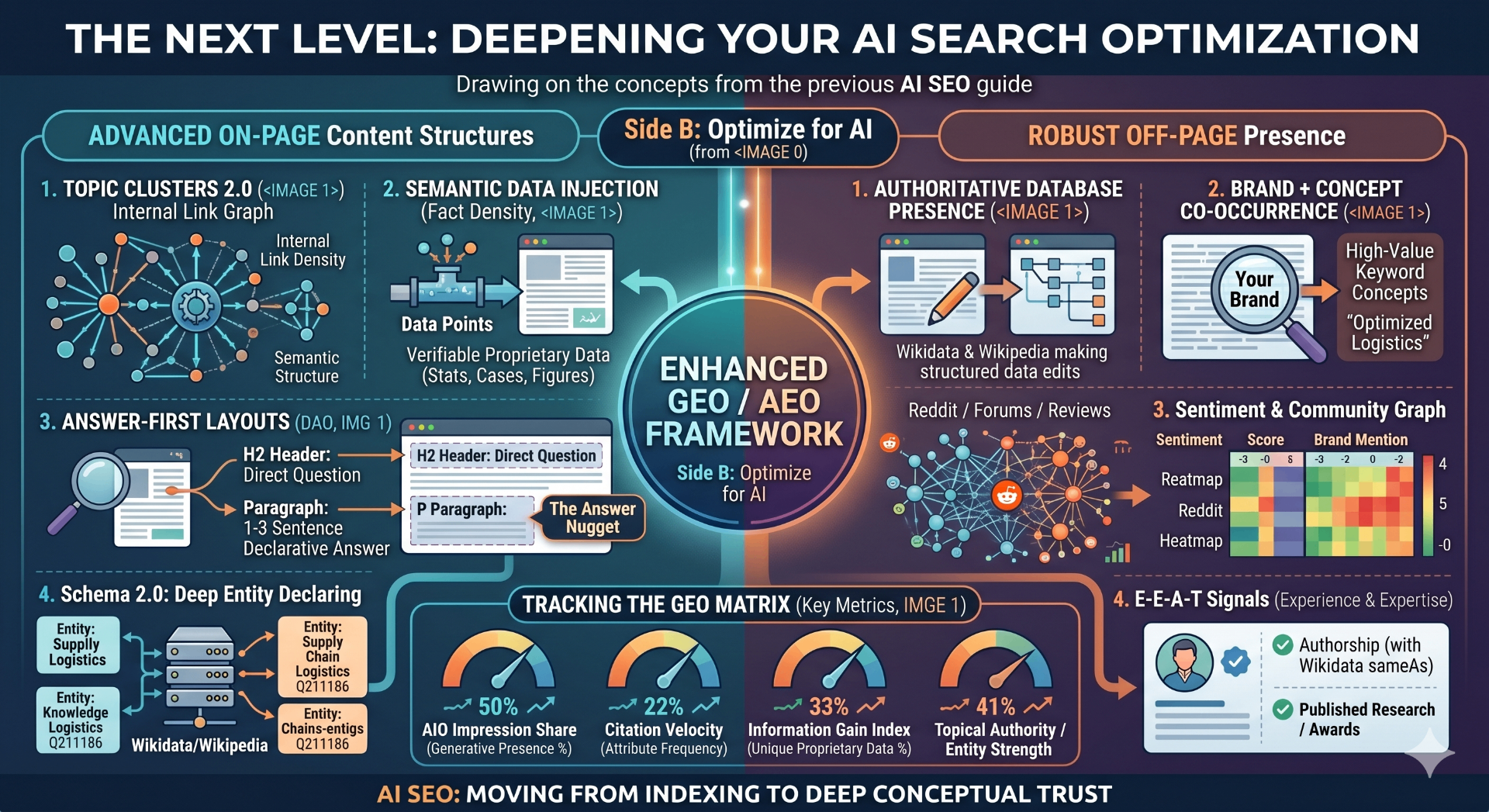
To secure the coveted featured citation block inside an AI summary, use the 1-3 Sentence Declarative Framework directly beneath an H2 question header.
Example H2: What is the latency threshold for edge-computed AI applications?
Optimized Answer Nugget: The absolute latency threshold for edge-computed AI applications is 12 milliseconds to prevent conversational lag. Edge configurations achieve this by deploying quantized 8-bit models directly onto localized gateway chipsets, reducing backhaul round-trips by 84%.
This structure allows the RAG system to seamlessly lift your text segment into its generative response without needing to modify, summarize, or truncate your syntax.
Credibility & Authority: Building Information Gain Moats
As generative AI makes it effortless to create generic text, search models have drastically increased the weight of Information Gain and E-E-A-T (Experience, Expertise, Authoritativeness, and Trustworthiness). If your content mirrors the average perspective already present within the LLM's training weights, it has zero retrieval utility.
A. Publish Proprietary Primary Datasets
To force AI engines to cite your brand, you must act as an Originator Source. This means publishing:
- Quarterly industry surveys or benchmarks.
- Original case studies packed with verifiable figures.
- System teardowns or architectural blueprints.
When an AI engine synthesizes a prompt requiring statistics (e.g., 'What is the average conversion lift from GEO?'), it is explicitly programmed to seek out the origin dataset node, completely protecting your site from being replaced by generic, AI-generated competitor content.
B. The 'Citation Loop' Strategy
AI models evaluate off-site authority by verifying brand associations across unlinked mentions on highly moderated, high-affinity platforms like Reddit, industry-specific developer forums, and authoritative digital press releases. Consistently cultivating clean mentions of your brand paired with your primary industry entity across these external platforms signals to the model's background embedding process that your entity is a trusted industry standard.
Metrics and Success Validation
Because AI search leads to an increase in 'zero-click' interactions, measuring success via classic organic click-through rates (CTR) will cause your data models to show false negatives. You must transition your core performance tracking to the GEO Success Matrix:
- AIO Citation Rate: The percentage of target long-tail or conversational queries where your URL is chosen as a primary source citation within AI summaries.
- Entity Strength & Semantic Proximity: Tracking how closely the AI maps your brand to core industry terms when explicitly asked for provider recommendations.
- Answer Nugget Density: Internal content audit metric tracking the number of direct, machine-extractable solutions per 1,000 words (Target: >= 6 direct answers per deep-dive asset).
By auditing your top revenue-generating content pages against this structured methodology, you convert your website from a passive archive of text into a high-performance machine interface optimized for the future of search.
Keep reading
AI SEO has two sides: using AI to boost your internal workflow, and optimizing your content so AI search engines actually cite you.
Practical, hands-on strategies to get your brand mentioned and recommended by AI engines.